


Preparing a Las Vegas business for sale involves more than reviewing financial statements, gathering equipment records, and finding an interested buyer. Before listing your company, you should examine its business licenses, government registrations, permits, ownership records, and any unresolved issues with local or state agencies.
A business can be profitable and still have licensing problems that complicate a sale. An expired State Business License, an outdated fictitious firm name filing, an unreported ownership change, or an unresolved permit condition can become a concern when a buyer begins reviewing the company.
There is another issue sellers often overlook. A business license does not automatically transfer to a new owner when the business is sold. Nevada licensing requirements depend on the legal structure of the transaction, the location of the business, and the types of licenses involved.
For owners throughout Las Vegas, NV | Henderson, NV | Summerlin, reviewing these matters before listing can help identify the government approvals that may be needed before a buyer takes over.
At Kaizen Strategies, we assist business owners with business licensing, Secretary of State filings, privileged licensing, and government approval matters.
This guide explains how to prepare your business licensing records for a sale, what happens when ownership changes, and which issues sellers should address before marketing their company.
Table of Contents
- Why Licensing Clean-Up Matters Before Selling
- Can Business Licenses Transfer to a Buyer in Nevada?
- Asset Sales vs. Entity Ownership Sales
- Review Your Nevada Secretary of State Records
- Check City and County Business License Status
- Clark County Ownership Change Requirements
- City of Las Vegas Ownership Change Requirements
- Henderson Business Sale and Licensing Requirements
- Clean Up DBA and Fictitious Firm Name Records
- Review Zoning, Permits, and Property Approvals
- Selling a Restaurant, Bar, or Liquor Business
- Gaming and Other Regulated Business Sales
- Nevada Tax Clearance and Outstanding Obligations
- What to Include in a Seller’s Licensing File
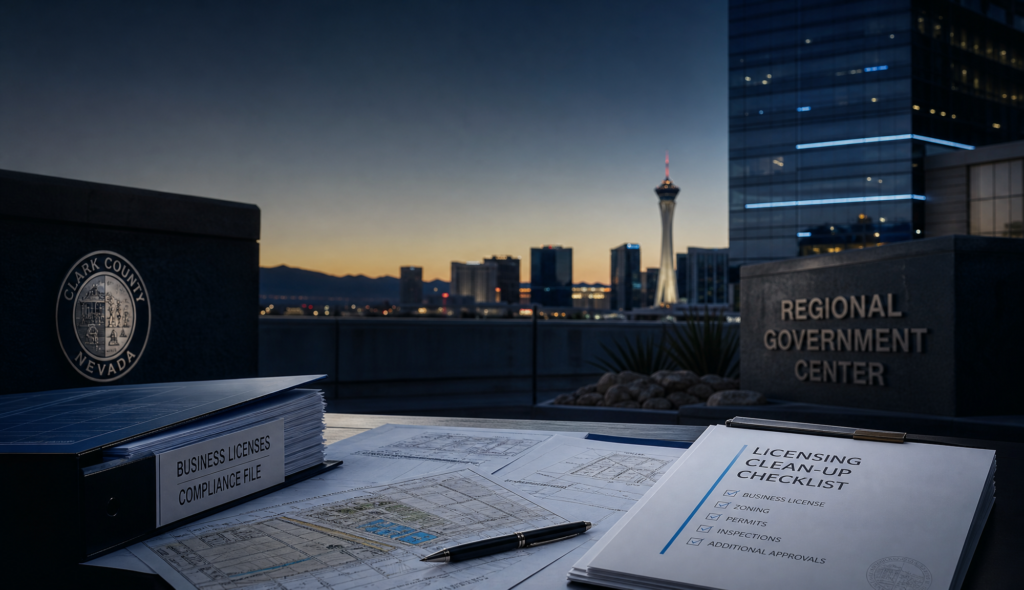
- Licensing Clean-Up Checklist Before Listing
- Common Mistakes That Complicate Business Sales
- Business Sales Across Southern Nevada
- How Kaizen Strategies Helps Business Sellers
- Frequently Asked Questions
- Sources and References
Why Licensing Clean-Up Matters Before Selling a Las Vegas Business
Preparing a Las Vegas business for sale should include a review of every government authorization connected to the company.
Buyers want to understand whether the business is properly licensed and what they must do to continue operating after the transaction.
An existing license may help demonstrate that the seller has operated through an established government approval process.
But it does not guarantee that the buyer will receive the same approval.
Licensing Problems Can Complicate a Sale
Imagine a restaurant owner who lists the business without checking the status of the liquor license.
During the buyer’s review, the parties discover that the business has an unresolved ownership disclosure or another licensing issue.
The buyer may need additional information before proceeding.
The parties may also have to reconsider their planned closing date while the applicable licensing requirements are addressed.
A similar problem can arise when a business has an expired local license, missing state filing, or unresolved inspection condition.
What Should Sellers Review?
Before listing, examine:
- Nevada State Business License status
- Annual list filings
- City or county business licenses
- Fictitious firm name registrations
- Regulated and privileged licenses
- Business ownership information
- Zoning and land use approvals
- Building and occupancy records
- Outstanding government notices
- State tax account records
- License renewal deadlines
- Permits that may require a new buyer application
The purpose is to understand the business’s current licensing position and what the potential transaction could change.
Can a Nevada Business License Transfer to a Buyer?
A business sale does not automatically transfer all government licenses and permits to the buyer.
Many licenses are issued to a named person or legal entity at a particular location.
The governing agency may require a new application, an ownership change filing, or advance approval.
Why the License Holder Matters
A license issued to one LLC is not necessarily valid for another LLC buying the business’s assets.
Even when the storefront, employees, and public business name remain the same, the person legally operating the establishment may change.
Licensing agencies need to know who is responsible for the business.
Do All Ownership Changes Require a New License?
No. The answer depends on the agency and the transaction.
Consider these local rules:
| Jurisdiction | Published Ownership Change Requirement |
|---|---|
| Unincorporated Clark County | A 100% change in licensed ownership generally requires a new business license application |
| City of Las Vegas | Its published ownership-change checklist calls for a new license application packet when the operating entity changes or ownership changes by 50% or more |
| Henderson | A purchaser cannot use the previous owner’s business license and must apply for a new license |
These rules should be reviewed alongside the current requirements for the particular license category.
Privileged and regulated businesses may face separate suitability reviews or advance approval requirements even when the change is smaller than the thresholds used for ordinary business licenses.
Check Before Advertising a Transferable License
A seller should avoid advertising a business license as transferable unless the responsible agency has confirmed that the proposed transaction allows it.

It is safer to describe the current licenses accurately and identify which approvals a buyer must pursue.
Asset Sale vs. Entity Sale: Why Transaction Structure Matters
Preparing a Las Vegas business for sale also requires understanding how the buyer intends to acquire it.
Two common arrangements are asset sales and ownership interest sales.
The differences can affect licensing.
Asset Sales
In an asset sale, the buyer purchases selected business assets rather than purchasing the seller’s legal entity.
Those assets might include:
- Equipment
- Furniture
- Inventory
- Business records
- Intellectual property
- Certain assignable contracts
- Other agreed business assets
The buyer may operate through a different LLC, corporation, or sole proprietorship.
Because the operating entity changes, new business license applications may be required.
A buyer cannot assume the seller’s licenses become part of the purchased equipment or inventory.
LLC Membership or Corporate Stock Sales
In an ownership interest sale, the buyer acquires membership interests or corporate shares.
The existing legal entity may remain in place.
But that does not mean the transaction is automatically exempt from licensing review.
The local government may require ownership disclosures, updated records, suitability investigations, or a new application based on the extent of the change.
Some regulated businesses also require approval before ownership interests can be transferred.
Which Sale Structure Is Better?
That is a legal and financial decision requiring review of the actual business.
Business sellers should work with qualified transaction counsel and tax professionals when choosing a structure.
For licensing purposes, the starting questions are:
- Will the operating legal entity change?
- What percentage of ownership will change?
- Which licenses are involved?
- Does any agency require advance approval?
- Can the buyer lawfully operate before the new approvals are issued?
Answering these questions before signing a purchase agreement can help the parties plan the licensing process.
Review Your Nevada Secretary of State Records Before Listing
One of the first steps in preparing a Las Vegas business for sale is checking the company’s records with the Nevada Secretary of State.
Buyers may want confirmation that the LLC or corporation is active and properly registered.
Check the Entity’s Current Status
The Secretary of State maintains records showing business entity status.
Review whether your company is:
- Active
- In default
- Revoked
- Dissolved
- Otherwise subject to an outstanding filing issue
The state’s Business Services page provides access to entity searches and the ORION Business Portal.
Confirm Annual Lists Are Current
Nevada LLCs and corporations generally must file annual lists.
LLCs report their managers or managing members.
Corporations report their officers and directors.
An annual list that is overdue may affect the company’s status.
Before listing, verify that the filing reflects the current management.
Review the State Business License
The Nevada Secretary of State’s State Business License FAQ explains that annual lists and State Business License renewals are filed together for covered business entities.
The state also provides information concerning penalties, default status, and reinstatement.
A seller should not assume that a local business license automatically means the state registration is current.
Correct Outdated Ownership Information
If the company has changed managers, officers, or other reportable information, determine whether an amended state filing is needed.
The records should accurately describe the entity being offered for sale.
Keep the Business Active During the Transaction
A seller should not dissolve the entity or cancel its business registrations merely because the business has been listed.
The timing of entity changes or closure depends on the transaction and its licensing requirements.
Premature cancellation can create problems if the company must remain authorized to operate before closing.
Kaizen Strategies provides Secretary of State filing assistance for businesses reviewing these records.
Check Your City or County Business License Status
A Nevada State Business License is separate from a local business license.
The city or county responsible for the company’s location may have its own records, renewal schedule, and ownership change procedures.
Verify the Local Licensing Jurisdiction
Do not rely only on the business’s mailing address.
Properties using Las Vegas postal addresses can fall inside incorporated city limits or in unincorporated Clark County.
The correct jurisdiction determines which agency handles the local business license.
Review Every License Classification
A business may hold multiple local authorizations.
A restaurant might have an ordinary business license and a liquor license.
A gaming establishment may need gaming-related approval in addition to its underlying business license.
A company offering several regulated activities may have other license categories.
Review every authorization, not just the main business license.
Check for Outstanding Licensing Issues
Before listing, determine whether the business has:
- Past-due renewals
- Unpaid license balances
- Unreported ownership changes
- Outstanding government document requests
- Open compliance notices
- Pending investigations
- License conditions that have not been satisfied
If issues exist, determine what must be done to address them.
Clark County Business License Ownership Changes Before a Sale
Business owners located in unincorporated Clark County must follow the county’s ownership change procedures.
The Clark County Business Licensing FAQ distinguishes partial ownership changes from a complete change of licensed ownership.
A 100% Ownership Change Generally Requires a New License
Under Clark County Code Section 6.04.072, a 100% change in licensed ownership generally requires a new business license application.
The existing business licenses automatically expire when that complete ownership change occurs.
Continued operation without the required new authorization is prohibited.
This means a seller should not promise that a buyer can continue operating indefinitely under the existing county license.
What About a Partial Ownership Change?
The county provides a change-of-license procedure for ownership changes below 100%.
Its Application for Change of Business License packet addresses owner and officer changes.
Additional requirements may apply to regulated, liquor, and gaming licenses.
A partial change does not automatically mean the county will approve the new ownership arrangement without review.
How Sellers Can Prepare
Before listing a business in unincorporated Clark County:
- Verify the current license record.
- Confirm all ownership interests on file.
- Review the license categories.
- Identify unpaid balances or incomplete changes.
- Ask the department how the proposed transaction will be treated.
- Plan for any required buyer application.
The county also requires licensees to notify it when a business closes or is sold.
Its FAQ describes the online closing procedure and an Out of Business form.
Do not close the seller’s license before confirming when operations will end and when the buyer may legally begin operating.
City of Las Vegas Business License Ownership Changes Before Listing
Businesses located within incorporated City of Las Vegas boundaries follow the city’s own licensing rules.
The city provides online account services for managing business license information.
Its Edit Business License Information page allows customers to access procedures involving changes to business names, locations, owners, and principals.
When Does a New Application Packet Apply?
The city’s published Change Location, Name, Ownership Checklist, revised July 15, 2021, states that changing the operating entity or changing ownership by 50% or more requires a new business license application packet.
Because the checklist has an older revision date, sellers should confirm the current procedure directly with the city before relying on that threshold for a transaction.
What Documents May Be Required?
The city’s checklist includes:
- Business license application
- State business registration information
- Responsible party acknowledgment
- Ownership information
- Supporting entity documents
- Background review documents when applicable
- Temporary license request when permitted
The exact requirements depend on the business and the proposed change.
Check Unpaid License Balances
The city’s Business License Application instructs businesses to resolve outstanding licensing balances before making changes or closing.
It also warns purchasers about outstanding license charges and amounts identified through earlier billing audits.
A seller should review the account and address unresolved charges before entering the final stages of a transaction.
What About Privileged Licenses?
A liquor, gaming, or other privileged business may face additional review.
The city directs privileged license applicants to its licensing staff for the applicable submission procedure.
Do not assume an ordinary ownership-change form is enough for a privileged establishment.
Henderson Business License Requirements When Selling a Business
Henderson has separate procedures for businesses being sold or closed.
The city’s Business Licensing FAQ directly addresses whether a buyer can use the previous owner’s business license.
Its answer is no.
Buyers Must Apply for Their Own License
Henderson states that a business license is issued to a particular person, firm, or corporation at a particular location.
A purchaser cannot simply use the seller’s license.
The buyer must file for a new license.
Sellers Must Notify the City
Henderson instructs business owners selling their establishments to email the Business Licensing Division so the city can cancel the applicable licenses.
The notice should include the business name, address, owner name, and owner’s signature.
For privileged businesses, including liquor and gaming establishments, additional municipal rules concerning closure and non-operational status may apply.
Don’t Cancel the License Too Early
The seller should coordinate the final operating date with the buyer’s application and the applicable agency requirements.
A license cancellation should not be treated as a routine administrative step to complete weeks before the business changes hands.
The parties need to know who will be legally responsible for operations at each stage.
Clean Up DBA and Fictitious Firm Name Records Before Selling
A business may operate publicly under a different name from its legal owner’s name.
In Nevada, this is commonly called a fictitious firm name or DBA.
NRS Chapter 602 governs assumed business names.
Confirm the DBA Matches the Current Owner
Suppose a company is publicly known as “Desert Valley Café,” but its legal operating entity is “Desert Hospitality LLC.”
The DBA filing should identify the correct legal owner.
If the DBA still lists a former sole proprietor or an outdated entity, the seller should examine what filing is needed to correct the record.
Review the Expiration Date
The Clark County Clerk requires fictitious firm names to be renewed every five years.
A seller should check that the registration is current.
Does a DBA Transfer With the Business?
A DBA filing does not automatically grant the buyer an unrestricted right to use the name.
The buyer may need a new assumed name registration identifying the new legal owner.
The business name may also be subject to separate contractual, trademark, or other rights.
Closing a Seller’s DBA Record
Under NRS 602.055, a person who terminates a business or ownership in a business operating under a fictitious name may file a certificate of termination.
The appropriate timing depends on the transaction.
The seller should coordinate any termination with the buyer’s new or updated registration.
Review Zoning, Permits, and Property Approvals Before Listing
Preparing a Las Vegas business for sale also involves reviewing the property’s approval history.
A business might hold a valid license but still have unresolved zoning or building issues.
Verify the Approved Property Use
Find out how the property is approved to operate.
A commercial space may have been approved for a restaurant, office, retail store, or another activity.
If the buyer intends to continue the same use, the existing approval history is helpful.
But it is not a guarantee that the buyer will automatically receive all necessary permits.
The City of Las Vegas business application guide cautions that approval of a previous tenant does not guarantee approval of a new tenant.
Review Special Use Permits
Some businesses operate under special use permits.
Those permits may contain conditions involving:
- Hours of operation
- Parking
- Noise
- Outdoor activities
- Security arrangements
- Building modifications
- Other property-specific requirements
A buyer needs to understand these conditions before taking over.
Kaizen Strategies assists property owners with special use permits and zoning variances.
Review Building and Fire Records
If the business uses a commercial building, gather available records concerning:
- Certificate of occupancy
- Building permits
- Fire inspections
- Approved floor plans
- Property alterations
- Open notices of violation
A buyer planning to remodel or expand may face additional requirements.
The seller should identify unresolved issues rather than leaving them to surface during the buyer’s review.
Examine the Lease
If the business leases its location, review whether the lease permits assignment or requires landlord consent for a transfer.
A business sale does not automatically transfer the lease.
If the lease includes an approved use restriction, the buyer’s planned operations should be compared with that restriction.
A qualified transaction attorney should review contractual rights and obligations.
Licensing Clean-Up When Selling a Restaurant, Bar, or Liquor Business
Restaurants, bars, taverns, and liquor establishments can have additional licensing issues.
A seller should examine the local liquor license and any health or property approvals connected to the operation.
Liquor Licenses Need Separate Attention
A retail liquor license is a regulated authorization, not simply an item of business property.
A change in legal ownership can require new applications, suitability investigations, and other government approvals.
The process depends on the local licensing authority.
Before listing, sellers should review the current license, approved alcohol activities, ownership information, and any outstanding conditions.
Kaizen Strategies provides privileged and liquor licensing assistance.
Food Establishment Permits Are Not Automatically Transferable
The Southern Nevada Health District states that a new health permit is required when the permitted food establishment changes ownership.
Its Change of Permit Holder FAQ explains the new permit process.
The Health District also states that there is no automatic grandfather exemption from current food safety requirements for a new owner.
A buyer may need to correct conditions that were acceptable or previously approved under an older arrangement.
Gather Inspection Records
Sellers should collect recent health inspection reports and records of completed corrections.
The Health District encourages prospective buyers to review the inspection history of an establishment before purchasing.
It also offers a pre-purchase inspection process with appropriate permission.
Review Alcohol Purchasing Accounts
A bar or restaurant may have accounts with multiple licensed wholesalers.
Outstanding invoices should be identified before the transaction.
Nevada regulates wholesale liquor purchasing and payment arrangements under NRS 369.485.
Supplier account balances and purchasing arrangements should be addressed as part of the transition planning.
The buyer should not assume every supplier account or agreement automatically transfers.
Selling a Gaming Business or Another Regulated Nevada Business
Some businesses require advance government approval before ownership changes can occur.
These matters deserve attention before the company is listed.
Gaming Establishments
Nevada has strict rules governing ownership interests in licensed gaming operations.
NRS 463.300 restricts gaming-related ownership transactions except as permitted under Nevada Gaming Commission regulations.
Nevada Gaming Commission Regulation 8 addresses transfers of ownership interests and related transactions.
A business owner selling a gaming operation should not assume that signing an asset purchase agreement or transferring LLC interests automatically authorizes the buyer to operate gaming.
Casino Changeovers
The Nevada Gaming Control Board’s Casino Closure and Changeover Procedures provide guidance concerning ownership transitions.
The Board explains that a new owner must have the appropriate license before taking over gaming operations unless an applicable regulatory permission allows earlier participation.
A casino or gaming establishment sale may therefore require coordination with state regulators well before closing.
Massage Establishments
Massage businesses have separate state and local establishment requirements.
The Nevada State Board of Massage Therapy regulates establishment certification under NAC Chapter 640C.
A buyer should verify whether the current certificate can be used after the transaction or whether a new application is required.
Learn more about Kaizen Strategies’ massage licensing services.
Residential Care Facilities
Under NRS 449.080, many Nevada health facility licenses are issued to the named licensee for the specified premises and are not transferable.
A purchaser of a licensed residential care business may therefore need a new facility license before operating.
Kaizen Strategies assists with assisted living facility licensing and related government approvals.
Cannabis and Other Privileged Operations
Cannabis establishments, certain regulated retail businesses, and other privileged licensees may have their own ownership disclosure and approval rules.
The applicable regulator and license category determine the procedure.
A seller should identify those requirements before representing that the business is ready for immediate transfer.
Nevada Tax Clearance and Outstanding Obligations Before a Business Sale
State tax accounts are another part of preparing a Las Vegas business for sale.
A buyer may request records showing that tax returns and payments are current.
Nevada law also provides protections for the collection of unpaid taxes when businesses are sold.
Nevada’s Successor Tax Liability Rule
Under NRS 360.525, a buyer or successor in a covered business sale must withhold sufficient consideration to address unpaid taxes or fees administered by the Nevada Department of Taxation until the seller supplies the required receipt or certificate.
A buyer who fails to satisfy the withholding requirement can face personal liability within the statutory limits.
This can directly affect how the parties structure closing and release sale proceeds.
What Is a Certificate of Amount Due?
NRS 360.525 provides a process through which a successor can request a certificate identifying amounts owed.
A seller should be prepared to address tax records and respond to reasonable requests involving this process.
The exact requirements depend on the transaction.
The seller, buyer, and their professional advisers should coordinate tax clearance and escrow arrangements.
Review State Tax Accounts
Before listing, examine whether the business has outstanding obligations involving:
- Sales and use tax
- Commerce Tax when applicable
- Modified Business Tax
- Other state tax accounts related to its activities
Determine whether all required returns have been filed and whether the account information is current.
What Happens to Tax Accounts After Closing?
The Nevada Department of Taxation’s Close a Business guidance explains how to close covered tax accounts.
The state notes that closing a sales, use, or Commerce Tax account does not automatically close every other state or local registration.
Modified Business Tax closure can also require action involving the Nevada Employment Security Division.
Do not close business tax accounts merely because the company has been listed. Closure should be coordinated with the actual end of operations and the transaction structure.
What to Include in a Business Seller’s Licensing File
One practical way to prepare a Las Vegas business for sale is to organize government records before buyers begin requesting them.
This can make it easier to answer questions accurately and identify missing information.
Business Entity Records
Collect:
- Articles of Organization or Incorporation
- Operating agreement or applicable corporate records
- Current annual list
- State Business License
- Registered agent information
- Amendments affecting ownership or management
- Secretary of State status information
Local Business License Records
Include:
- Current city or county business license
- All related license categories
- Renewal notices
- Ownership change filings
- Approved operating conditions
- Correspondence concerning outstanding issues
Property Records
Gather:
- Lease or property ownership records
- Certificate of occupancy
- Relevant zoning approvals
- Special use permits
- Variances when applicable
- Approved building or fire records
- Available inspection documentation
Regulated Industry Records
Depending on the business, include:
- Liquor license documentation
- Gaming license records
- Health permits
- Massage establishment certificate
- Residential care facility license
- Other applicable state or local authorizations
Tax and Business Name Records
Review:
- Nevada Department of Taxation registrations
- Relevant tax account records
- Fictitious firm name certificates
- Tax notices or unresolved account issues
- Documents addressing previously reported ownership changes
The purpose is to provide an accurate picture of the business, not to promise that every approval can be transferred.
Licensing Clean-Up Checklist Before Listing Your Las Vegas Business
Use this checklist when preparing a Las Vegas business for sale.
It can help identify the filings and approvals that deserve attention before a buyer begins reviewing the company.
Phase 1: Verify Business Identity
- Confirm the legal entity name.
- Check the Secretary of State entity status.
- Review the current annual list.
- Confirm the State Business License is active.
- Review reported officers, managers, and owners.
- Verify registered agent information.
Phase 2: Review Local Licensing
- Identify the correct city or county.
- List every local license held by the business.
- Check expiration and renewal dates.
- Review outstanding balances.
- Identify unresolved licensing notices.
- Confirm the procedures for a proposed ownership change.
Phase 3: Examine Property Approvals
- Confirm the approved zoning use.
- Review special use permits or variances.
- Check building and occupancy records.
- Gather available fire inspection records.
- Review lease assignment provisions.
- Identify unresolved property approval conditions.
Phase 4: Review Regulated Licenses
- Confirm the status of liquor, gaming, health, or other regulated licenses.
- Identify advance approval requirements.
- Determine whether the buyer needs new applications.
- Gather requested inspection and operating records.
- Identify any required ownership suitability reviews.
Phase 5: Review Financial and Tax Filings
- Confirm state tax account information.
- Review outstanding returns and balances.
- Discuss NRS 360.525 requirements with transaction advisers.
- Identify licensing or tax accounts that will need closure after the sale.
- Plan the timing of seller and buyer government notifications.
This checklist is a starting point. The actual requirements depend on the company, its licenses, and the proposed transaction.
Common Licensing Mistakes That Complicate Nevada Business Sales
Several mistakes can create problems after a business has already attracted a buyer.
Mistake 1: Advertising Licenses as Automatically Transferable
The seller’s existing licenses do not automatically give the buyer permission to operate.
Each government authorization must be reviewed under its own rules.
Mistake 2: Ignoring Expired State Filings
An LLC or corporation in default may need additional filings before the transaction proceeds.
Check the Secretary of State record before listing.
Mistake 3: Failing to Report Earlier Ownership Changes
A business may have changed members or officers without updating all government records.
These discrepancies can become apparent during the sale.
Mistake 4: Overlooking Health and Privileged Licenses
A general business license does not replace liquor, gaming, health, or another regulated approval.
The seller should identify every applicable authorization.
Mistake 5: Assuming the Buyer Can Use Existing Property Approvals Without Review
Some approvals are tied to the property, while others depend on the operator or licensed activity.
A new owner or changed business use may trigger further review.
Mistake 6: Closing Licenses Before the Business Stops Operating
Canceling a license too early can affect the seller’s ability to continue lawful operations.
Closure timing should be coordinated with the transaction.
Mistake 7: Leaving Outstanding Tax Questions Until Closing
Nevada’s successor withholding law can affect the buyer’s handling of sale proceeds.
Tax account issues deserve attention before the transaction reaches its final stage.
Mistake 8: Promising an Immediate Gaming or Liquor Changeover
Regulated businesses may require investigations or advance approval.
A purchase agreement should not assume a buyer can automatically begin operating on the planned closing date.
Preparing a Business for Sale in Las Vegas, NV | Henderson, NV | Summerlin
Business sale preparation differs across Southern Nevada because local licensing rules differ.
A company located within the incorporated City of Las Vegas follows city procedures.
A company in unincorporated Clark County follows county requirements.
A business in Henderson works with Henderson’s Business Licensing Division.
Summerlin Business Locations
Summerlin includes commercial properties under different local governments.
Some are located within incorporated City of Las Vegas boundaries.
Others fall under unincorporated Clark County.
A seller should confirm the property’s legal jurisdiction before preparing an ownership change filing.
Businesses Serving Several Jurisdictions
A company may operate from one location while maintaining business licenses in additional cities or counties.
The seller should review each authorization separately.
Changing ownership of the company may affect more than its home jurisdiction license.
The Value of Early Licensing Review
Before placing a business on the market, identify the government authorizations involved and what the buyer must do after the transaction.
This allows the seller to describe the business accurately and makes it easier for the parties to discuss licensing conditions during negotiations.
How Kaizen Strategies Helps With Business Sale Licensing Clean-Up
Preparing a Las Vegas business for sale can involve state filings, city or county licensing records, ownership changes, permit reviews, and communication with government agencies.
At Kaizen Strategies, we help business owners understand these requirements and prepare for the applicable licensing procedures.
Our firm serves Las Vegas, NV | Henderson, NV | Summerlin.
Our team includes former high-ranking government officials, attorneys, and licensing professionals with more than 20 years of combined business, community, and governmental relations experience.
Our Business Licensing and Government Services
Depending on the business, Kaizen Strategies can assist with:
- Business licensing
- Secretary of State filings
- Business formation
- Government representation
- Privileged and liquor licensing
- Gaming licensing
- Special use permits
- Zoning variances
- Land entitlement
- Reviewing government licensing records
- Preparing ownership change documentation
- Identifying additional application requirements
- Organizing supporting records for agency review
Our work focuses on licensing and government approval matters. Business valuation, purchase agreements, tax structuring, and sale negotiations should be handled by appropriately qualified professionals.
Selling a Business in Southern Nevada?
Before listing your company, confirm that your government records accurately reflect how the business operates.
An expired license, missing ownership filing, or unresolved permit issue may require attention before the buyer can take over.
Kaizen Strategies helps owners throughout Las Vegas, NV | Henderson, NV | Summerlin review their licensing and government filing requirements.
Call Kaizen Strategies at (725) 247-6828 to discuss business licensing clean-up before a sale.
You can also visit our Contact Us page to schedule an appointment.
Office Address: 4485 S Buffalo Dr # E, ZIP 89147
Business Hours: Monday through Saturday, 9 AM to 6 PM.
Contact Kaizen Strategies to discuss your company’s licenses, ownership records, and government approval requirements before listing your business.
Frequently Asked Questions About Preparing a Las Vegas Business for Sale
1. Can I sell my Nevada business with its existing business license?
You can sell a business that holds a current license, but the license does not automatically transfer to the buyer. The process depends on the business location, legal entity, ownership change, and license category. Clark County generally requires a new application for a complete ownership change, while Henderson requires purchasers to obtain their own business licenses. Regulated activities may have separate approval requirements.
2. Do I need to renew my Nevada State Business License before selling?
If the business continues operating and remains subject to the State Business License requirement, the license should remain current. LLCs and corporations generally must also maintain annual list filings. An overdue filing can affect the entity’s status and create questions during the sale process. Review the company’s Secretary of State record before listing and coordinate any eventual dissolution or closure with the transaction.
3. Can a buyer take over my Clark County business license?
Under Clark County’s general business licensing rules, a 100% change in licensed ownership generally requires a new business license application. Partial ownership changes follow a separate change-reporting procedure, although additional review can apply to regulated businesses. The buyer should not operate under the seller’s license after a complete ownership change without obtaining the required authorization.
4. What happens to a restaurant’s health permit when the business is sold?
The Southern Nevada Health District requires a new health permit when a permitted food establishment changes ownership. The buyer must follow the applicable change-of-permit-holder process. Existing facilities do not receive an automatic exemption from current health requirements simply because the previous owner operated there. The seller should gather available inspection records and identify unresolved issues before the transaction.
5. Can I sell a Las Vegas bar or gaming business without new license approval?
The sale may require separate liquor or gaming licensing approvals before the buyer can operate. Nevada gaming ownership transactions are subject to state rules, and the Gaming Control Board provides changeover procedures for licensed gaming establishments. Local liquor licenses may also require ownership investigations or new applications. The parties should confirm the applicable requirements before setting an operating transition date.
6. Should I close my business licenses as soon as I list the company?
No. Listing a business for sale does not mean the company has stopped operating. Premature license cancellation may affect its ability to continue lawful operations. The correct timing depends on when the seller ends operations, whether the buyer needs new licenses, and any regulatory changeover requirements. Business owners should coordinate closure notices with the actual transaction and government instructions.
7. Who can help clean up business licensing records before a sale in Nevada?
Kaizen Strategies assists owners with business licensing, Secretary of State filings, ownership change procedures, government representation, and regulated licensing matters. Our team includes former high-ranking government officials, attorneys, and licensing professionals with more than 20 years of combined business and governmental relations experience. We serve Las Vegas, NV | Henderson, NV | Summerlin. Call (725) 247-6828 or visit Kaizen Strategies Contact Us to schedule an appointment.
Sources and References
The following government resources support the ownership change, business licensing, entity filing, tax clearance, and regulated business sale requirements discussed in this article.
1. Clark County Business Licensing Frequently Asked Questions
- Publisher: Clark County Department of Business License
- Publication Date: Not listed; accessed October 30, 2026
- URL: https://www.clarkcountynv.gov/business/doing_business_with_clark_county/faq
2. Application for Change of Business License
- Publisher: Clark County Department of Business License
- Publication Date: Document revision date not clearly listed; accessed October 30, 2026
- URL: https://www.clarkcountynv.gov/assets/documents/business/doing_business_with_clark_county/divisions/business_license_billing___payments/change-form-packet.pdf
3. Edit Business License Information
- Publisher: City of Las Vegas Business Licensing Division
- Publication Date: Not listed; accessed October 30, 2026
- URL: https://www.lasvegasnevada.gov/Business/Business-License/Edit-Business-License-Information
4. Change Location, Name, Ownership Checklist
- Publisher: City of Las Vegas Business Licensing Division
- Publication Date: Revised July 15, 2021
- URL: https://files.lasvegasnevada.gov/business-licensing/Change-Location-Name-Ownership-Checklist.pdf
5. Business Licensing Frequently Asked Questions
- Publisher: City of Henderson
- Publication Date: Not listed; accessed October 30, 2026
- URL: https://www.cityofhenderson.com/government/departments/business-licensing/faqs
6. Nevada Secretary of State: Business Services
- Publisher: Nevada Secretary of State
- Publication Date: Not listed; accessed October 30, 2026
- URL: https://nvsos.gov/sos/businesses/
7. State Business License Frequently Asked Questions
- Publisher: Nevada Secretary of State
- Publication Date: Not listed; accessed October 30, 2026
- URL: https://nvsos.gov/sos/licensing/state-business-license/state-business-license-faq
8. Fictitious Firm Name Registration
- Publisher: Clark County Clerk
- Publication Date: Forms updated March 2026; accessed October 30, 2026
- URL: https://www.clarkcountynv.gov/government/elected_officials/county_clerk/fictitious-firm-name
9. Nevada Revised Statutes, Chapter 602: Doing Business Under an Assumed or Fictitious Name
- Publisher: Nevada Legislature
- Publication Date: Consolidated statutory compilation; accessed October 30, 2026
- URL: https://www.leg.state.nv.us/NRS/NRS-602.html
10. Nevada Revised Statutes, Chapter 360: General Tax Provisions
- Publisher: Nevada Legislature
- Publication Date: Consolidated statutory compilation; accessed October 30, 2026
- URL: https://www.leg.state.nv.us/NRS/NRS-360.html
11. Close a Business
- Publisher: Nevada Department of Taxation
- Publication Date: Not listed; accessed October 30, 2026
- URL: https://tax.nv.gov/manage-a-business/close-a-business/
12. Change of Permit Holder Frequently Asked Questions
- Publisher: Southern Nevada Health District
- Publication Date: Not listed; accessed October 30, 2026
- URL: https://www.southernnevadahealthdistrict.org/permits-and-regulations/plan-review/faq/change-of-permit-holder-faq/
13. Nevada Revised Statutes, Chapter 369: Intoxicating Liquor, Licenses and Taxes
- Publisher: Nevada Legislature
- Publication Date: Consolidated statutory compilation; accessed October 30, 2026
- URL: https://www.leg.state.nv.us/NRS/NRS-369.html
14. Nevada Revised Statutes, Chapter 463: Licensing and Control of Gaming
- Publisher: Nevada Legislature
- Publication Date: Consolidated statutory compilation; accessed October 30, 2026
- URL: https://www.leg.state.nv.us/NRS/NRS-463.html
15. Casino Closure and Changeover Procedures
- Publisher: Nevada Gaming Control Board
- Publication Date: Current agency resource page; accessed October 30, 2026
- URL: https://www.gaming.nv.gov/divisions/tax-license-division/casino-closure-changeover-procedures/
16. Nevada Revised Statutes, Chapter 449: Medical Facilities and Other Related Entities
- Publisher: Nevada Legislature
- Publication Date: Consolidated statutory compilation; accessed October 30, 2026
- URL: https://www.leg.state.nv.us/NRS/NRS-449.html
17. Apply for a Business License
- Publisher: City of Las Vegas Business Licensing Division
- Publication Date: Not listed; accessed October 30, 2026
- URL: https://www.lasvegasnevada.gov/Business/Business-License/Apply-For-A-Business-License
Disclaimer: This article provides general educational information about preparing a business for sale, Nevada business licensing, ownership changes, tax clearance, and government approval procedures as reviewed on October 30, 2026. It does not determine whether a particular license may be retained, changed, or reissued in a proposed transaction. Business sales can involve separate legal, tax, licensing, and contractual requirements. Sellers and purchasers should confirm current rules with the responsible agencies and consult qualified transaction professionals before completing a sale.

