

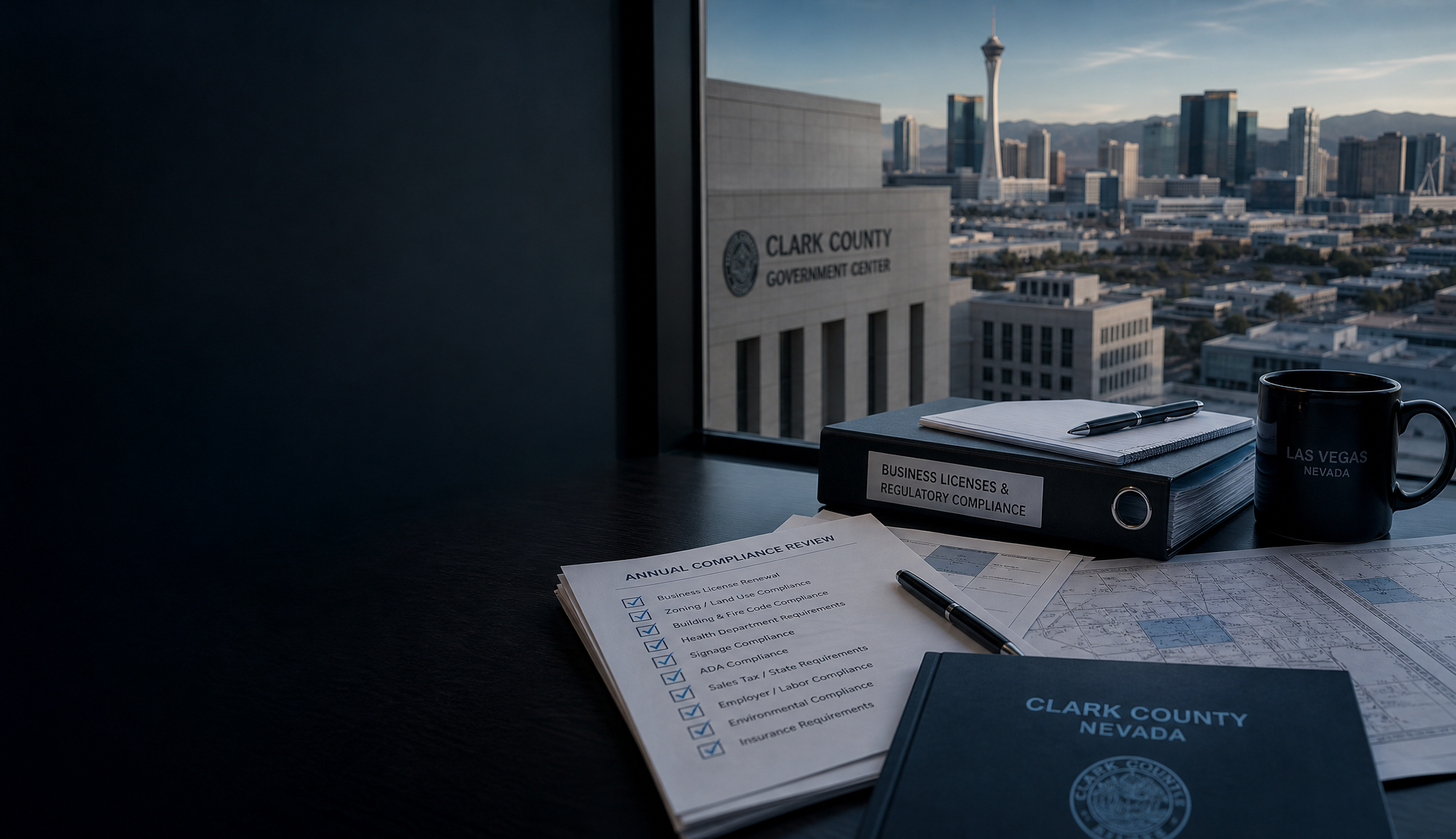
Annual regulatory reviews for Las Vegas licensed businesses help owners catch expired licenses, outdated company records, missed tax filings, and permit problems before those issues interfere with daily operations. Even a business that has operated for years without trouble should review its government authorizations regularly.
A Nevada State Business License, local business license, professional credential, liquor license, or health permit may have its own renewal schedule. Some expire annually. Others renew quarterly, every six months, or every two years. Certain permits remain valid until a change in ownership, location, or business activity requires further review.
That is why an annual business licensing review should examine more than expiration dates.
Owners also need to check whether their business is still operating under the same name, at the same location, with the same ownership and activities that government agencies have approved.
For companies throughout Las Vegas, NV | Henderson, NV | Summerlin, a yearly review provides an opportunity to identify outstanding filing requirements and prepare for upcoming agency deadlines.
At Kaizen Strategies, we help Nevada businesses with business licensing, Secretary of State filings, privileged licensing, and government representation.
This guide explains what licensed businesses should check every year, which filings may come due more frequently, and how to prepare a practical review checklist.
Table of Contents
- Why Annual Regulatory Reviews Matter
- What Should an Annual Business License Review Include?
- Nevada State Business License and Annual List Filings
- City and County Business License Renewals
- Business Ownership, Management, and Address Records
- DBA and Fictitious Firm Name Registrations
- Nevada Tax Filings and Account Reviews
- Liquor and Gaming License Reviews
- Health Permits and Inspection Records
- Professional and Industry-Specific Licenses
- Zoning, Building, and Fire Approval Reviews
- Employee Licensing and Insurance Records
- Reviewing Short-Term Rental and Lodging Permits
- Building an Annual Licensing Calendar
- Common Mistakes During Annual License Reviews
- Annual Licensing Reviews Across Southern Nevada
- How Kaizen Strategies Helps Licensed Businesses
- Frequently Asked Questions
- Sources and References
Why Annual Regulatory Reviews Matter for Las Vegas Businesses
Many business owners complete their initial licensing applications and then concentrate on serving customers.
But government requirements continue after a license is issued.
Businesses must renew certain authorizations, maintain accurate records, report qualifying changes, and follow any conditions attached to their licenses.
An annual licensing review helps owners examine those responsibilities together.
Small Filing Problems Can Become Bigger Problems
Consider an LLC that renews its local business license but forgets its Nevada Secretary of State annual list.
The local license may still appear current, while the state entity has fallen into default.
Now imagine a restaurant that renews its ordinary business license but overlooks a separate liquor license renewal.
The restaurant’s general license does not replace its liquor privileges.
These examples show why owners should review each authorization individually.
An Annual Review Is Not the Same as Annual Renewal
This distinction matters.
A yearly review is a business practice. A renewal deadline is a legal requirement set by the issuing agency.
Some obligations occur more than once per year.
Henderson generally renews business licenses every six months, with gaming licenses following a quarterly cycle.
Clark County liquor and gaming licenses generally renew quarterly.
Nevada’s State Business License generally renews annually.
An owner should examine all these deadlines during the annual review and track each one throughout the year.
What Should an Annual Business License Review Include?
Start by gathering every license and permit connected to your business.
Do not rely on one folder labeled “business license” if the company operates several regulated activities.
Annual Review Checklist
| Area to Review | What to Verify | Typical Timing |
|---|---|---|
| Nevada State Business License | Active status and renewal date | Annual |
| LLC or corporation annual list | Officers, managers, filing status | Annual |
| Local business license | Classification, expiration, authorized activities | Varies |
| Liquor and gaming licenses | Active privileges and ownership records | Often quarterly locally |
| Sales and use tax | Filing frequency, returns, account details | Monthly, quarterly, or annual |
| Modified Business Tax | Payroll reporting and account status | Quarterly when applicable |
| Commerce Tax | Whether Nevada revenue triggers filing | Annual when applicable |
| Fictitious firm name | Registered owner and expiration | Review annually; Clark County renewal every five years |
| Health permits | Current permit and inspection history | Review annually; renewal as required |
| Professional licenses | Individual credentials and establishment certificates | Depends on profession |
| Zoning and building approvals | Approved use, occupancy, outstanding conditions | Review annually and after changes |
| Insurance | Required coverage and policy expiration | Review annually and before expiration |
| Ownership and address records | Whether filings match actual operations | Whenever changes occur |
This list does not mean every business needs all these permits.
A consulting office, restaurant, massage establishment, gaming tavern, and assisted living facility have different requirements.
The annual review should match the company’s actual activities.
Nevada State Business License and Annual List Filings
An annual regulatory review should begin with the Nevada Secretary of State.
Under Nevada Revised Statutes Chapter 76, most businesses operating in Nevada need a State Business License unless an applicable statutory exemption or exclusion applies.
LLCs and corporations also have annual entity filing responsibilities.
When Is a Nevada LLC Annual List Due?
Under NRS 86.263, Nevada LLCs generally file annual lists identifying their managers or managing members.
The deadline is ordinarily the last day of the company’s formation anniversary month, subject to any approved alternative filing date.
The State Business License renewal is completed with the annual list.
What About Nevada Corporations?
NRS 78.150 establishes annual list requirements for corporations.
These filings identify the corporation’s officers and directors.
The corporation’s State Business License renewal generally accompanies its annual list filing.
What Should Owners Check?
During the annual review:
- Verify the entity’s current status.
- Confirm the State Business License expiration date.
- Check the annual list filing history.
- Verify the registered agent.
- Review manager, officer, and director information.
- Determine whether amendments are needed.
- Save copies of filing confirmations.
The Nevada Secretary of State’s State Business License FAQ explains annual renewal requirements and default status.
What Happens If You Miss a Filing?
Nevada can place an entity into default when required filings are missed.
Continued default can result in revocation.
The business may need to complete additional filings to restore its status.
Owners should not assume that operating without interruption means every state registration remains active.
Where Can You Check Your Business Status?
The Secretary of State provides business search and filing services through its Business Services page.
Nevada’s current online business filing system is ORION.
Some older government instructions still reference SilverFlume, so follow the Secretary of State’s current portal guidance.
Kaizen Strategies assists with Secretary of State filings and business entity records.
City and County Business License Renewals in Southern Nevada
A Nevada State Business License is separate from the local licenses required by cities and counties.
Businesses should review each local authorization and its renewal schedule.
Clark County Business License Reviews
Unincorporated Clark County licenses can have different renewal cycles depending on the license classification.
Many general business licenses are billed semiannually.
Some regulated categories follow annual, semiannual, or quarterly schedules.
Certain licenses are also based on gross revenue.
Clark County’s Business License Billing and Payment Forms provide information about renewals and reporting.
Owners should verify that:
- The license classification matches current activities.
- Revenue information has been reported correctly.
- Required renewals were completed.
- Any related regulated license remains active.
- The county has current ownership and location records.
City of Las Vegas Business License Reviews
The incorporated City of Las Vegas provides an online business licensing dashboard.
The city’s Edit Business License Information page allows license holders to manage business information and certain changes.
During your review, confirm the expiration dates and renewal rules for your actual license classifications.
Do not assume every city license follows the same billing schedule.
Henderson Business License Reviews
Henderson’s Business Licensing FAQ states that most city business licenses are valid for six months and renew semiannually.
Gaming licenses are valid for three months and renew quarterly.
Henderson also states that business owners are responsible for renewing on time even if they do not receive a courtesy notice.
That is a good reason to maintain an independent renewal calendar.
Businesses With More Than One Location
A company operating in several jurisdictions may have multiple local licenses.
Review every location individually.
An active license for one storefront does not automatically establish that another location is properly authorized.
Review Ownership, Management, and Business Address Records
An annual licensing review should compare the information government agencies have on file with the way the company actually operates.
Changes can occur throughout the year.
The business may have added an owner, changed managers, relocated, or begun offering additional services.
Ownership and Management Changes
Review whether the company has:
- Added or removed LLC members.
- Changed corporate officers.
- Appointed new managers.
- Transferred ownership interests.
- Changed its legal operating entity.
- Reorganized its business structure.
Some changes require amended government filings.
Privileged license holders may need advance approval or suitability review before ownership changes are completed.
Business Name and Address Changes
Check the business’s legal name, public operating name, mailing address, and physical location.
These should match the records required by the relevant agency.
The Nevada Department of Taxation requires businesses to report changes involving ownership, addresses, business activities, federal identification numbers, and additional locations.
New Services and Business Activities
A business might have added another service line without reviewing its local license.
A restaurant could have added entertainment.
A retailer might now provide repair services.
A wellness business may have introduced massage therapy.
The local licensing agency should confirm whether the new activity is covered by the existing license.
Do Not Wait for the Annual Review to Report Changes
Some changes require notice or approval when they occur.
The annual review is an opportunity to discover omissions, not permission to delay a required filing.
Check DBA and Fictitious Firm Name Registrations
Businesses operating under assumed names should review their fictitious firm name records each year.
In Nevada, these registrations are governed by NRS Chapter 602.
The certificate identifies the person or entity using the business name.
Does a DBA Renew Every Year?
Not in Clark County.
The Clark County Clerk states that fictitious firm names must be renewed every five years.
The Clerk updated its filing forms in March 2026.
Even though the renewal is not annual, owners should check the expiration date during their yearly review.
What If the Business Has Changed Owners?
A DBA certificate may still identify a former individual owner or legal entity.
Review whether the certificate accurately reflects the current business owner.
A business name registration does not automatically transfer ownership or create a separate legal entity.
What Records Should You Keep?
Maintain:
- The current fictitious firm name certificate.
- Its filing and expiration dates.
- Any amendments or termination documents.
- Records linking the assumed name to the correct entity.
An expired or outdated DBA can create problems when applying for licenses or updating business information.
Nevada Tax Filings Every Licensed Business Should Review
Licensing and tax registration are separate responsibilities.
An annual business licensing review should include a check of the company’s Nevada tax accounts.
The tax rules depend on the company’s activities, employees, and revenue.
Sales and Use Tax
Businesses making taxable sales generally need the appropriate Nevada sales and use tax registration.
Filing schedules may be monthly, quarterly, or annual, depending on the account’s assigned frequency.
Nevada changed its sales and use tax return deadline in 2026.
The Nevada Department of Taxation states that sales and use tax returns are now due on the 20th day of the applicable following month.
This change began with the January 2026 reporting period, due February 20, 2026.
Owners should verify that their accounting calendar reflects the current deadline.
Modified Business Tax
Employers subject to Nevada Unemployment Compensation Law are generally also subject to Modified Business Tax requirements, with statutory exceptions.
The Department of Taxation’s Modified Business Tax page identifies quarterly reporting requirements.
The state resumed wage comparisons between unemployment insurance records and Modified Business Tax filings on January 1, 2026.
Businesses should review whether reported payroll information matches across the applicable agencies.
Commerce Tax
Nevada’s Commerce Tax applies to businesses with Nevada gross revenue exceeding $4 million during the fiscal year.
According to the Department’s Commerce Tax FAQ, a business at or below that threshold generally is not required to file a Commerce Tax return.
An annual review should determine whether revenue has crossed the filing threshold.
Do not assume that every LLC or corporation automatically needs a Commerce Tax return.
Update Tax Account Information
The Department of Taxation requires updated registration information when certain business details change.
Check whether the department has the correct:
- Business name
- Ownership
- Mailing and physical addresses
- Federal identification number
- Business activities
- Additional business locations
Business owners should coordinate tax questions with a qualified accounting or tax professional.
Annual Liquor and Gaming License Reviews for Nevada Businesses
Bars, taverns, restaurants, casinos, and other regulated establishments need to pay attention to their privileged licenses.
These authorizations can involve continuing suitability requirements and more frequent renewal schedules.
Clark County Liquor License Renewals
Clark County’s official billing guidance states that liquor licenses generally renew quarterly.
A restaurant or tavern should review its approved liquor activities and confirm that all quarterly renewals are current.
The license should match the beverages sold and the approved areas where alcohol is served.
Clark County Gaming License Renewals
Clark County also states that local gaming licenses renew quarterly.
The renewal relates to the approved gaming operations and devices.
This is separate from state gaming taxes, licensing records, and other Nevada gaming requirements.
See the county’s Gaming and Liquor Renewal Forms.
Ownership and Management Disclosures
Clark County’s Liquor and Gaming Division handles matters involving ownership changes, business reorganizations, and certain regulated personnel.
During the annual review, verify whether any changes were properly reported or approved.
Gaming Records and Operating Conditions
The Nevada Gaming Control Board administers state gaming oversight.
Gaming license holders should examine the authorizations applicable to their operations, including approved gaming activities, reporting duties, and ownership disclosures.
The Board’s Tax and License Division also performs reviews of certain gaming licensees.
A business’s internal annual review does not replace any government inspection, audit, or licensing investigation.
Check Actual Activities Against Approved Privileges
A restaurant that adds a new bar area or entertainment activity should verify that its existing approvals cover the change.
A tavern with gaming should verify that the operation continues to satisfy the applicable license conditions.
Kaizen Strategies provides privileged and liquor licensing and gaming licensing assistance.
Health Permits and Inspection Records: What to Check Each Year
Restaurants, food establishments, and certain other businesses need permits from the Southern Nevada Health District.
An annual licensing review should include current permit documents and recent inspection records.
Food Establishment Permits
The Southern Nevada Health District oversees food establishment operating requirements.
Depending on the operation, a business may have permits for restaurants, food preparation, or other covered activities.
Check whether the permit remains active and whether any renewal obligations apply.
Food Inspections
The Health District states that it conducts unannounced inspections of food establishments at least once a year.
Inspection frequency can also depend on the operation’s risk category and inspection history.
The District publishes reports through its Restaurant Inspection Search.
Owners should review recent inspection findings and whether corrective actions were completed.
Changes Requiring Plan Review
A restaurant that remodeled its kitchen, installed additional equipment, or changed its food preparation process may need separate review.
The District’s Plan Review program handles applications involving new establishments, remodeling, and changes in permit holders.
A current health permit does not automatically authorize every expansion or change of use.
Other Health-Regulated Businesses
Depending on the operation, health permits or inspections may also apply to:
- Public accommodations
- Aquatic facilities
- Body art businesses
- Certain childcare operations
- Other activities under Health District authority
Review the requirements applicable to the actual business category.
Professional and Industry-Specific Licenses to Check Annually
Some businesses depend on licenses issued by state regulatory boards or specialized agencies.
The owner should review both the business authorization and any credentials required of employees or managers.
Massage Establishments
Nevada massage establishments require a state establishment certificate under the Board of Massage Therapy’s rules.
The Nevada State Board of Massage Therapy also requires professionals practicing massage therapy to hold the appropriate individual licenses.
Establishment certificates generally renew annually.
Individual massage therapy licenses generally renew every two years.
Nevada approved new continuing education rules in September 2026, so business owners should follow the Board’s updated Licensee guidance.
Assisted Living and Residential Care Facilities
Residential facilities for groups and assisted living operations have separate state facility licensing requirements.
Owners should review:
- Current facility license status
- Approved resident capacity
- Administrator credentials
- Staff qualifications
- Required operating records
- Fire and safety documentation
- Unresolved inspection findings
The state agency responsible for residential facility licensing is the Bureau of Health Care Quality and Compliance under the Nevada Health Authority.
Kaizen Strategies assists with assisted living facility licensing.
Cannabis Businesses
Cannabis establishments have specialized state and local licensing responsibilities.
An annual review should cover the current authorization, approved activities, ownership information, and any reporting obligations imposed by the applicable regulator.
See Kaizen Strategies’ marijuana licensing services.
Contractors and Other Licensed Professions
Construction, health care, and other professions can require individual or business credentials from separate boards.
Owners should verify that the company and its licensed professionals remain authorized for the work being performed.
Do not assume an employee’s expired professional license is covered by the company’s general business license.
Zoning, Building, and Fire Approval Reviews
Not every government approval has an annual renewal date.
Some land use and property approvals remain in effect subject to conditions, while others may expire or require action after a business changes its operation.
That makes property approvals another part of an annual licensing review.
Confirm the Approved Property Use
Review whether the business still operates under the use approved for the location.
Changes that may require attention include:
- Expanding into another suite
- Adding a commercial kitchen
- Converting a retail property into a nightclub
- Adding outdoor entertainment
- Changing building occupancy
- Introducing a regulated service
- Enlarging customer seating areas
Special Use Permits and Zoning Variances
Some properties operate under special use permits, zoning variances, or other land use approvals.
These may contain conditions concerning operating hours, parking, outdoor activities, noise, or the physical property.
Review those conditions each year.
Kaizen Strategies provides special use permit assistance and zoning variance services.
Building and Fire Records
Check whether the company has:
- Current required inspections
- Open correction notices
- Fire safety maintenance records
- Approved occupancy documents
- Required building permits for recent construction
- Completed inspection confirmations
The actual inspection and maintenance schedule depends on the building, equipment, and applicable fire or building codes.
Do not assume a city or county requires the same annual inspection for every property.
Planning Property Changes?
A new development or major property change may require additional land use approval.
Kaizen Strategies assists with land entitlement and related government matters.
Employee Licensing, Payroll Registration, and Insurance Reviews
Businesses with employees should include personnel records and required insurance in their yearly review.
These responsibilities are separate from ordinary business licensing.
Workers’ Compensation
Nevada generally requires employers with one or more employees to maintain workers’ compensation insurance unless a statutory exclusion applies.
Review whether the current policy matches the business and its workforce.
A lapse in coverage can create legal and financial exposure.
The Nevada Division of Industrial Relations oversees workers’ compensation requirements.
Payroll and Employer Accounts
Verify whether unemployment insurance and applicable payroll tax accounts are current.
The business should reconcile relevant wage information and examine outstanding notices.
The Department of Taxation’s 2026 Modified Business Tax wage comparison procedures make consistent payroll reporting especially important.
Employee Professional Credentials
Certain employees must hold licenses or certifications.
A business should verify whether the credentials required for the person’s duties remain current.
Examples can include massage therapists, licensed contractors, residential care administrators, and other regulated professionals.
Insurance Required by Specific Licenses
Some local licenses also require proof of liability insurance.
Short-term rentals are one example.
Other regulated activities may have bonding or insurance requirements.
Compare each policy’s expiration date and coverage description with the conditions of the applicable license.
Short-Term Rental and Lodging Permit Reviews
Property owners operating licensed short-term rentals should examine both their local authorization and the continuing operating rules.
The requirements differ among Southern Nevada jurisdictions.
Clark County Short-Term Rentals
Under Clark County Code Chapter 7.100, qualifying licensed short-term rentals must maintain the applicable license and follow continuing operating conditions.
These include requirements involving:
- Liability insurance
- Guest occupancy
- Local representatives
- Advertising
- Property records
- Transient lodging taxes
- Other license conditions
The county’s original Short-Term Rental application window remains closed as of October 30, 2026.
An existing license holder should not confuse renewal requirements with the process for obtaining a new license.
City of Las Vegas and Henderson Rentals
The incorporated cities have their own short-term rental licensing or registration procedures.
Owners should review the requirements that apply to their individual property.
A license issued by one jurisdiction does not authorize a rental in another.
Hotels and Lodging Businesses
Hotels and other lodging operators should review their local business license, applicable health and property permits, and lodging tax accounts.
The licensing requirements differ from those governing ordinary residential short-term rentals.
Kaizen Strategies provides short-term rental licensing assistance.
How to Build an Annual Licensing Review Calendar
The easiest way to keep track of multiple licenses is to create a calendar that records each requirement separately.
Do not build the calendar around only one anniversary date.
Different agencies have different deadlines.
Create a Master License Register
For every license or permit, record:
| Information | What to Enter |
|---|---|
| License or permit | Official name and category |
| Issuing agency | Secretary of State, city, county, board, or other agency |
| Legal license holder | Individual, LLC, corporation, or other entity |
| Authorized location | Address or properties covered |
| Authorized activity | What the license permits |
| Expiration date | Date shown on the authorization |
| Reporting schedule | Monthly, quarterly, semiannual, annual, or other |
| Last action completed | Filing, renewal, inspection, or notice |
| Responsible person | Staff member or adviser assigned to the item |
| Next action | Renewal, amendment, inspection, or agency follow-up |
Keep supporting documents alongside the register.
Review Obligations Monthly
Some government deadlines occur monthly.
A recurring monthly check can include sales tax accounts and any local lodging tax obligations.
This should not replace an annual review. It supplements it.
Review Obligations Quarterly
Quarterly checks may cover:
- Applicable Clark County liquor or gaming licenses
- Modified Business Tax returns
- Employer payroll filings
- Other quarterly reporting obligations
The correct reporting periods depend on the business and issuing agency.
Review Obligations Every Six Months
Henderson generally renews its non-gaming business licenses semiannually.
Many Clark County general business licenses also follow semiannual cycles.
Businesses operating in these jurisdictions should set reminders according to their actual license periods.
Complete a Full Review Once a Year
Choose a consistent month to examine the entire licensing register.
During this review:
- Check all license statuses.
- Verify entity and ownership information.
- Confirm future renewal dates.
- Review tax accounts.
- Examine inspection history.
- Review property use and permits.
- Verify required insurance and professional credentials.
- Identify missing documents or agency follow-up.
- Assign responsibility for corrections.
- Save an updated record for the next review.
A yearly review does not excuse missing an earlier statutory filing deadline.
Common Mistakes During Annual Regulatory Reviews
Several recurring mistakes can leave licensed businesses with unresolved government requirements.
Assuming Every License Renews Annually
Some renew monthly, quarterly, semiannually, or every two years.
Other records may only need updating when information changes.
Review the actual schedule.
Checking Only the State Business License
A current Nevada State Business License does not establish that the company has met its local licensing, health, or privileged licensing requirements.
Ignoring Ownership Changes
An ownership or management change may require updated filings or agency approval.
Some changes cannot simply be reported at the next renewal.
Forgetting About Additional Business Locations
New locations may require local licenses and tax registration updates.
Review the authorization for every business address.
Overlooking New Activities
Adding alcohol service, massage therapy, entertainment, gaming, or another regulated activity may trigger a separate application.
The existing business license may not cover the new service.
Missing Tax Reporting Changes
Nevada updated sales and use tax return deadlines in 2026.
An outdated accounting calendar can cause late filings.
Relying Only on Renewal Notices
Government agencies may send reminders, but businesses remain responsible for filing and renewal deadlines.
Maintain independent records.
Ignoring Old Inspection Findings
An unresolved health, fire, or property issue should be addressed under the agency’s instructions.
Do not assume the next inspection will automatically resolve an earlier finding.
Annual Regulatory Reviews in Las Vegas, NV | Henderson, NV | Summerlin
Businesses throughout Southern Nevada face many of the same state requirements, but local licensing schedules and procedures are different.
A company should identify which government has authority over each location.
Incorporated City of Las Vegas
Businesses inside city limits should review their City of Las Vegas license records through the city’s licensing system.
Check activities, ownership, expiration dates, and property approvals.
Privileged businesses may need additional review through the responsible licensing department.
Unincorporated Clark County
Businesses in unincorporated Clark County should review county business licenses and any regulated or privileged authorizations.
Some licenses are connected to gross revenue reporting, while others have separate renewal schedules.
Henderson
Henderson generally follows a six-month renewal cycle for non-gaming business licenses and a quarterly cycle for gaming licenses.
A business operating there should track those dates separately from its Nevada Secretary of State anniversary.
Summerlin
Summerlin includes properties within City of Las Vegas boundaries and unincorporated Clark County.
The correct local business licensing agency depends on the property’s actual jurisdiction.
The neighborhood name alone does not establish which rules apply.
Businesses Operating Across Multiple Jurisdictions
A company may maintain several local licenses for different locations or activities across Las Vegas, NV | Henderson, NV | Summerlin.
Each authorization should have its own entry in the annual review register.
How Kaizen Strategies Helps With Annual Business Licensing Reviews
An annual regulatory review can involve state entity filings, local business licenses, government notices, privileged licenses, tax registrations, and land use records.
For a regulated business, these requirements may involve several separate agencies.
At Kaizen Strategies, we help business owners understand government licensing procedures, prepare applications, and address related approval matters.
Our firm serves Las Vegas, NV | Henderson, NV | Summerlin.
Our team includes former high-ranking government officials, attorneys, and licensing professionals with more than 20 years of combined business, community, and governmental relations experience.
Our Business Licensing and Government Services
Depending on the company, Kaizen Strategies can assist with:
- Business licensing
- Secretary of State filings
- Business formation
- Government representation
- Privileged and liquor licensing
- Gaming licensing
- Massage licensing
- Assisted living facility licensing
- Special use permits
- Zoning variances
- Land entitlement
- Reviewing license classifications and government filing requirements
- Organizing supporting application documents
- Preparing ownership or business activity changes
- Addressing requests from licensing agencies
Our services focus on licensing and government approval matters. Tax returns, insurance coverage, and legal opinions should be reviewed with appropriately qualified professionals.
Need Help Reviewing Your Business Licenses?
If your company operates under several licenses, has changed ownership, expanded services, or opened additional locations, a review can help identify which government filings deserve attention.
Do not wait until a renewal deadline passes or a pending business transaction reveals a missing authorization.
Call Kaizen Strategies at (725) 247-6828 to discuss your business licensing needs.
You can also visit our Contact Us page to schedule an appointment.
Office Address: 4485 S Buffalo Dr # E, ZIP 89147
Business Hours: Monday through Saturday, 9 AM to 6 PM.

Kaizen Strategies assists licensed business owners throughout Las Vegas, NV | Henderson, NV | Summerlin with licensing reviews, government filings, and related approval procedures.
Frequently Asked Questions About Annual Business Licensing Reviews in Las Vegas
1. What should a Las Vegas business check during an annual license review?
A business should review its Nevada State Business License, applicable Secretary of State annual list, local business licenses, permit expiration dates, tax account records, and ownership information. Regulated businesses should also check liquor, gaming, health, professional, and property approvals when applicable. Look for unresolved agency notices, changes in business activities, and missing documents. The exact checklist depends on the company’s licenses and operations.
2. Do all Nevada business licenses renew once a year?
No. Nevada State Business Licenses generally renew annually. Many local business licenses follow different schedules. Henderson generally renews non-gaming business licenses every six months and gaming licenses quarterly. Clark County liquor and gaming licenses generally renew quarterly, while many county general business licenses are billed semiannually. Professional licenses and specialized permits have their own expiration dates.
3. When is a Nevada LLC annual list and State Business License renewal due?
A Nevada LLC generally files its annual list and State Business License renewal by the last day of the company’s formation anniversary month, unless an approved alternative due date applies. The LLC must also maintain its required registered agent. Owners should verify the entity’s active status and renewal date through the Nevada Secretary of State’s current business filing system.
4. Should I review my business tax accounts every year?
Yes. A business should review its Nevada tax registrations, filing schedules, and outstanding notices. Sales and use tax returns are now due on the 20th of the applicable following month under Nevada’s 2026 deadline change. Covered employers generally file Modified Business Tax returns quarterly. Businesses exceeding the applicable Nevada gross revenue threshold may also need to file Commerce Tax returns. Consult a qualified tax professional for account-specific questions.
5. Do restaurants and bars need an annual licensing review if they already pass inspections?
Yes. Health inspections and business licensing are separate responsibilities. A restaurant may need current food establishment permits, local business licensing, and a liquor license. The Southern Nevada Health District conducts food establishment inspections at least annually, but a successful inspection does not automatically renew the restaurant’s local or privileged business licenses. Owners should review each authorization separately.
6. What happens if my Nevada business license or required filing is overdue?
The consequences depend on the filing and issuing agency. Missing Nevada Secretary of State annual filings can cause an entity to fall into default and eventually face revocation. Local licensing agencies may impose penalties or take other action when required renewals are missed. A business should contact the responsible agency to determine how to correct the problem and whether operations may continue while the issue is being resolved.
7. Who can help with annual business licensing reviews in Las Vegas?
Kaizen Strategies assists business owners with licensing requirements, Secretary of State filings, privileged licensing, government representation, and related approval matters. Our team includes former high-ranking government officials, attorneys, and licensing professionals with more than 20 years of combined business and governmental relations experience. We serve Las Vegas, NV | Henderson, NV | Summerlin. Call (725) 247-6828 or visit our Contact Us page to schedule an appointment.
Sources and References
The following government resources support the annual filing, local renewal, tax registration, privileged licensing, health inspection, and business record requirements discussed in this article.
1. Nevada State Business License Frequently Asked Questions
- Publisher: Nevada Secretary of State
- Publication Date: Not listed; accessed October 30, 2026
- URL: https://nvsos.gov/sos/licensing/state-business-license/state-business-license-faq
2. Nevada Secretary of State Business Services
- Publisher: Nevada Secretary of State
- Publication Date: Not listed; accessed October 30, 2026
- URL: https://nvsos.gov/sos/businesses/
3. Nevada Revised Statutes, Chapter 76: State Business Licenses
- Publisher: Nevada Legislature
- Publication Date: Current statutory compilation; accessed October 30, 2026
- URL: https://www.leg.state.nv.us/NRS/NRS-076.html
4. Nevada Revised Statutes, Chapter 86: Limited-Liability Companies
- Publisher: Nevada Legislature
- Publication Date: Current statutory compilation; accessed October 30, 2026
- URL: https://www.leg.state.nv.us/NRS/NRS-086.html
5. Nevada Revised Statutes, Chapter 78: Private Corporations
- Publisher: Nevada Legislature
- Publication Date: Current statutory compilation; accessed October 30, 2026
- URL: https://www.leg.state.nv.us/NRS/NRS-078.html
6. Clark County Business License Billing, Renewal, and Payment Forms
- Publisher: Clark County Department of Business License
- Publication Date: Not listed; accessed October 30, 2026
- URL: https://www.clarkcountynv.gov/business/doing_business_with_clark_county/divisions/business_license_billing___payments/forms
7. Clark County Business License Audit Frequently Asked Questions
- Publisher: Clark County Department of Business License
- Publication Date: Not listed; accessed October 30, 2026
- URL: https://www.clarkcountynv.gov/business/doing_business_with_clark_county/divisions/business_license_audit/faq
8. Edit Business License Information
- Publisher: City of Las Vegas Business Licensing Division
- Publication Date: Not listed; accessed October 30, 2026
- URL: https://www.lasvegasnevada.gov/Business/Business-License/Edit-Business-License-Information
9. Business Licensing Frequently Asked Questions
- Publisher: City of Henderson
- Publication Date: Not listed; accessed October 30, 2026
- URL: https://www.cityofhenderson.com/government/departments/business-licensing/faqs
10. Update a Business
- Publisher: Nevada Department of Taxation
- Publication Date: Not listed; accessed October 30, 2026
- URL: https://tax.nv.gov/manage-a-business/grow-a-business/
11. Nevada Department of Taxation: Sales and Use Tax Deadline Notice
- Publisher: Nevada Department of Taxation
- Publication Date: 2026 update; accessed October 30, 2026
- URL: https://tax.nv.gov/
12. Modified Business Tax
- Publisher: Nevada Department of Taxation
- Publication Date: Includes 2026 wage comparison guidance; accessed October 30, 2026
- URL: https://tax.nv.gov/tax-types/modified-business-tax/
13. Commerce Tax Frequently Asked Questions
- Publisher: Nevada Department of Taxation
- Publication Date: Not listed; accessed October 30, 2026
- URL: https://tax.nv.gov/faqs/commerce-tax-faqs/
14. Fictitious Firm Name Registration
- Publisher: Clark County Clerk
- Publication Date: Forms updated March 2026; accessed October 30, 2026
- URL: https://www.clarkcountynv.gov/government/elected_officials/county_clerk/fictitious-firm-name
15. Privileged Business Licensing: Liquor and Gaming
- Publisher: Clark County Department of Business License
- Publication Date: Not listed; accessed October 30, 2026
- URL: https://www.clarkcountynv.gov/business/doing_business_with_clark_county/divisions/liquor_and_gaming/about-us
16. Nevada Gaming Control Board: Tax and License Division
- Publisher: Nevada Gaming Control Board
- Publication Date: Current agency information; accessed October 30, 2026
- URL: https://www.gaming.nv.gov/divisions/tax-license-division/
17. Food Establishment Operations
- Publisher: Southern Nevada Health District
- Publication Date: Not listed; accessed October 30, 2026
- URL: https://www.southernnevadahealthdistrict.org/permits-and-regulations/food-establishment-operations/
18. Restaurant Inspection Search
- Publisher: Southern Nevada Health District
- Publication Date: Not listed; accessed October 30, 2026
- URL: https://www.southernnevadahealthdistrict.org/permits-and-regulations/restaurant-inspections/restaurant-inspection-search/
19. Massage Therapy Licensee Information
- Publisher: Nevada State Board of Massage Therapy
- Publication Date: Updated October 2026
- URL: https://www.massagetherapy.nv.gov/licensees/
20. Massage Establishment Certification
- Publisher: Nevada State Board of Massage Therapy
- Publication Date: Current agency guidance; accessed October 30, 2026
- URL: https://www.massagetherapy.nv.gov/establishments2/
21. Short-Term Rental Units
- Publisher: Clark County Department of Business License
- Publication Date: Application status notice updated April 15, 2024; accessed October 30, 2026
- URL: https://www.clarkcountynv.gov/business/doing_business_with_clark_county/divisions/regulated_business/short_term_rentals/
Disclaimer: This article provides general educational information about Nevada business licensing, government filings, permit reviews, inspections, and tax registration requirements as reviewed on October 30, 2026. Not every item applies to every business, and not every permit renews annually. License conditions, renewal dates, reporting schedules, and government procedures may change. Business owners should verify requirements with each responsible agency and seek qualified legal, tax, or insurance advice where appropriate.

