


What is a gaming license? In Nevada, a gaming license is an authorization that allows a person or business to engage in gaming or pari-mutuel wagering under state or local law. For a business owner, that can cover anything from operating a small number of slot machines at an eligible location to running a casino, sportsbook, gaming route, or another regulated gaming operation.
Nevada does not treat a gaming license like an ordinary business permit. State law describes gaming licenses and approvals as revocable privileges. Applicants are subject to a licensing review that can examine ownership, finances, business history, personal history, proposed operations, and the people connected to the business.
That distinction matters for owners in Las Vegas, NV | Henderson, NV | Summerlin. Opening a business that includes gaming can involve state approval along with county or city licensing, zoning, business formation, and other approvals tied to the location.
If you are considering gaming as part of a new or existing business, understanding the process before filing paperwork can save you from preventable setbacks.
Table of Contents
- What Is a Gaming License in Nevada?
- Why Nevada Requires Gaming Licenses
- Restricted vs. Nonrestricted Gaming Licenses
- What Businesses May Need a Gaming License?
- Who Reviews a Nevada Gaming License Application?
- What Does Nevada Review During the Licensing Process?
- State and Local Gaming Licensing
- Why Location Matters Before You Apply
- Common Gaming License Application Problems
- How Kaizen Strategies Helps With Gaming Licensing
- Gaming License FAQs
- Sources
What Is a Gaming License in Nevada?
Nevada law defines a gaming license as a license issued by the state or a political subdivision that authorizes the named person to engage in gaming or pari-mutuel wagering.
That definition sounds short, but a gaming license can involve far more than submitting one form.
Under Nevada law, a person generally cannot operate or allow gaming activities such as gambling games, slot machines, race books, or sports pools without first obtaining the licenses or registrations required by federal, state, county, or municipal rules that apply to the operation.
You can read the statutory language in Nevada Revised Statutes Chapter 463.
For Nevada business owners, the practical question is not only, “Do I need a gaming license?”
You may also need to determine:
- What type of gaming license fits the proposed operation?
- Which individuals or entities must be disclosed?
- Is the proposed location suitable for gaming?
- Does the business need state and local approval?
- Will ownership interests trigger separate licensing or suitability reviews?
- Are zoning or land-use approvals needed?
- Does the business structure match what appears in the gaming application?
- Does the planned gaming activity match the license being requested?
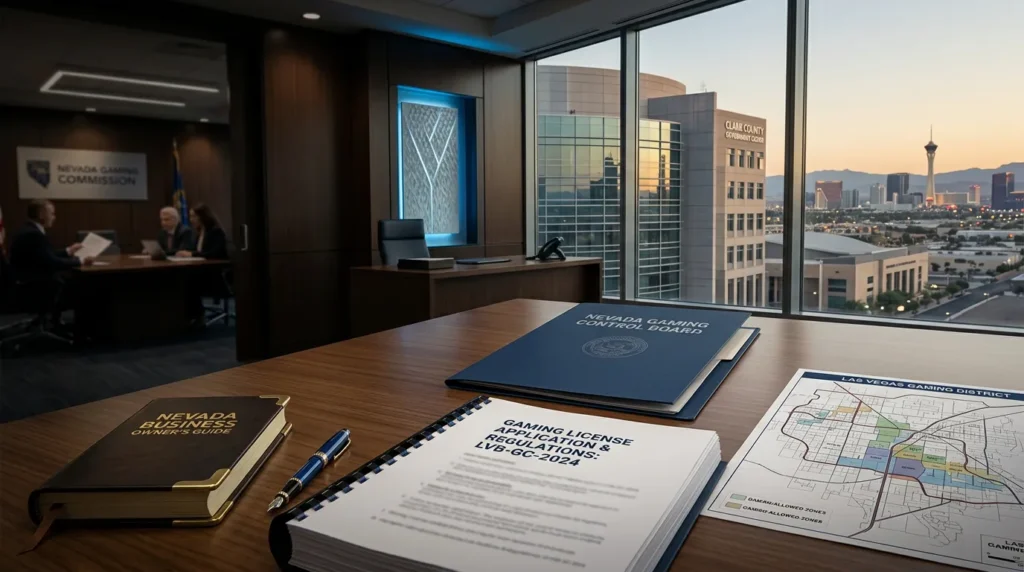
These questions are easier to address before a lease is signed, ownership changes hands, or construction begins.
Why Nevada Requires Gaming Licenses
Nevada closely regulates gaming because licensed gaming involves money, public trust, ownership interests, financial transactions, employees, equipment, and regulated wagering activity.
The Nevada Gaming Control Board investigates applicants before gaming licenses and certain approvals are issued. Nevada law places the burden on the applicant to show that the applicant meets the state’s licensing standards.
Under NRS 463.170, the Nevada Gaming Commission considers matters that include character, honesty, integrity, prior activities, criminal history when applicable, reputation, habits, associations, business ability, and financing.
For a license to operate a gaming establishment, applicants may also have to show that the proposed financing is suitable for the planned operation.
This means a gaming license application can reach far beyond the business itself.
Depending on the ownership and management structure, the review may involve owners, officers, directors, members, managers, shareholders, people with financial interests, and other persons connected with the proposed gaming activity.
Restricted vs. Nonrestricted Gaming Licenses
One of the first distinctions Nevada business owners should understand is the difference between a restricted and nonrestricted gaming license.
What Is a Restricted Gaming License?
A restricted gaming license generally covers an operation with 15 or fewer gaming devices where gaming is incidental to the main business.
The Nevada Gaming Control Board currently provides a separate application path for restricted gaming licenses.
A restricted license may come into play in settings where slot machines are part of a larger non-gaming operation. The exact facts of the location and business activity matter.
Business owners should not assume that having fewer than 16 machines automatically means a proposed location will qualify. The business model, location, ownership, lease arrangements, proposed gaming activity, and applicable local rules must still be reviewed.
The Nevada Gaming Control Board lists its current restricted application materials on its Forms and Applications page.
What Is a Nonrestricted Gaming License?
Nevada law generally defines a nonrestricted operation as one involving:
- 16 or more slot machines;
- Any number of slot machines together with another game, gaming device, race book, or sports pool at the same establishment; or
- A slot machine route.
A casino operation is the clearest example, but nonrestricted licensing is not limited to the large resort properties people associate with the Las Vegas Strip.
The type of gaming being conducted determines which license category and application requirements may apply.
Now here’s the thing: the number of machines is only one part of the analysis. The planned activity, ownership, location, business structure, and other facts can change the licensing path.
What Businesses May Need a Gaming License?
A Nevada gaming license can apply to more businesses than first-time applicants expect.
Depending on the activity, licensing or gaming approval may be connected with:
- Casinos
- Taverns offering gaming
- Certain bars or restaurants with slot machines
- Sportsbooks
- Race books
- Slot machine route operations
- Gaming device manufacturers
- Gaming device distributors
- Interactive gaming businesses
- Gaming service providers
- Gaming salons
- Businesses receiving certain gaming revenue interests
Some business models fall into specialized categories with their own application requirements.
The Nevada Gaming Control Board’s forms page lists separate applications for nonrestricted gaming, restricted gaming, manufacturers and distributors, interactive gaming operators, information services, gaming salons, slot machine routes, and other regulated activities.
If gaming will be connected with your business in any way, identifying the correct license category should happen early.
Owners in Las Vegas, NV | Henderson, NV | Summerlin may also need to coordinate the gaming application with ordinary business licensing, entity filings, zoning, and local licensing rules.
Who Reviews a Nevada Gaming License Application?
Two state bodies play major roles in Nevada gaming licensing:
Nevada Gaming Control Board
The Nevada Gaming Control Board receives applications and investigates applicants.
Its Investigations Division states that it investigates gaming license and key employee applicants to assess matters such as business integrity, viability, and suitability. Investigators prepare reports used during the licensing process.
You can learn more from the Nevada Gaming Control Board Investigations Division.
Nevada Gaming Commission
The Nevada Gaming Commission acts on gaming license applications after the Gaming Control Board’s investigation and recommendation process.
Nevada statutes set out the application, investigation, recommendation, and Commission action process in NRS Chapter 463.
This structure means applicants should prepare for more than document filing. The process can involve questions, supporting records, investigation, public meetings, and review of people or entities connected to the applicant.
What Does Nevada Review During the Licensing Process?
A gaming license investigation can be much more detailed than a standard business license review.
The exact information depends on the license sought and the applicant, but Nevada application materials can call for information about the proposed licensee, business location, proposed gaming, direct and indirect financial interests, personal history, and ownership.
Ownership and Business Structure
Nevada’s gaming application statute requires disclosure of the people who are directly or indirectly interested in the business and the nature of those interests.
This can make entity planning a major part of the process.
If you are still forming the company, Kaizen Strategies can also assist with business formation and Nevada Secretary of State filings.
Ownership changes during the licensing process can create extra work, so the proposed structure should be reviewed before documents are filed.
Personal Background
Nevada law directs regulators to consider an applicant’s character, honesty, integrity, prior activities, criminal record if any, reputation, habits, and associations.
Applicants should answer application questions fully and accurately.
An old issue does not always tell you the final result of an application. Failing to disclose requested information can create a different problem.
If you are unsure whether something must be disclosed, getting guidance before filing can help prevent conflicting or incomplete answers.
Financial Information
Gaming regulators may review the financing behind a gaming operation.
The state has an interest in understanding who is funding the business, where funds come from, who has financial interests, and whether the proposed operation has adequate financing for its structure.
Depending on the application, applicants may have to supply financial documents and supporting records.
Proposed Gaming Activity
Your application must match what the business actually plans to do.
NRS 463.200 states that a state gaming license application must include information such as the proposed licensee’s name, the business location, the games or gaming devices to be operated, and people with direct or indirect interests.
A change in the plan can affect the licensing work.
State and Local Gaming Licensing
A Nevada gaming license does not always end the licensing discussion.
Nevada law contemplates state, county, and municipal gaming licensing. NRS 463.160 bars covered gaming operations unless the required licenses and registrations are in place.
NRS 463.180 states that a person seeking a county gaming license must hold a valid state license and meet applicable county qualifications.
NRS 463.190 provides that gaming operations in a city or town require the valid state and county licenses as well as licenses required by the city or town.
What this means is that jurisdiction matters.
A property with a Las Vegas mailing address is not automatically inside the City of Las Vegas. Parts of the Las Vegas Valley fall under Clark County or another city.
That is why the physical location should be checked before deciding where local licensing documents must be filed.
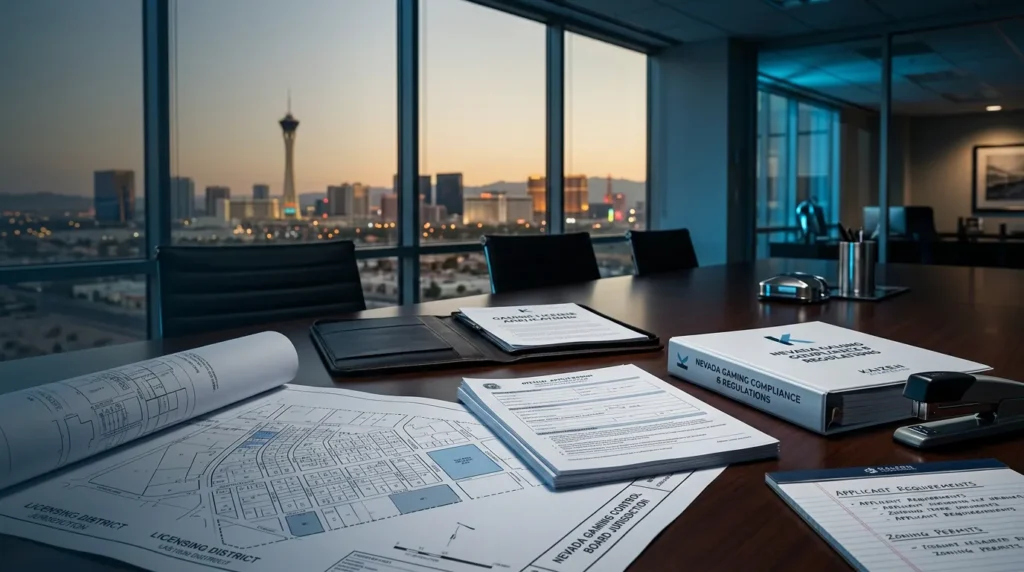
This is especially relevant for businesses serving Las Vegas, NV | Henderson, NV | Summerlin because businesses across the valley may fall under different local authorities.
Why Location Matters Before You Apply
Gaming licensing and land use can overlap.
A business concept may sound workable from a licensing standpoint but still face a location issue. Before committing to a property, an owner may need to determine whether the planned activity is allowed at that site and whether a land-use approval is required.
This is where special use permits, zoning variances, and land entitlement can become part of the same project.
Here is why: signing a lease does not guarantee that the location can legally support every proposed business activity.
A licensing plan should account for both the operator and the property.
Before committing to a location, consider questions such as:
- Which government has jurisdiction over the address?
- Is gaming permitted at that location?
- Is a special use permit required?
- Does the planned occupancy match the intended use?
- Are there conditions attached to the property?
- Will the local business license require separate investigation?
- Does the lease address gaming activity?
- Is the proposed operation restricted or nonrestricted?
Addressing these questions early can reduce the chance that one government approval stalls the rest of the project.
Common Gaming License Application Problems
Gaming license applications can run into trouble when the filing does not match the people, property, or business arrangement behind the application.
Filing Before the Business Structure Is Settled
If owners, members, managers, or financial interests are still changing, filing too early may mean updating forms or supplying more records later.
Using the Wrong Jurisdiction
Southern Nevada contains several licensing jurisdictions. Filing with the wrong local authority can slow the process.
Verify the jurisdiction tied to the physical address rather than relying only on the city name in the mailing address.
Incomplete Ownership Information
Nevada asks for information about direct and indirect interests in a gaming business.
Ownership agreements, funding arrangements, management rights, and other financial relationships should be examined before filing.
Waiting Too Long to Address Zoning
A gaming license cannot solve a land-use problem.
If the proposed business needs a special use permit or other zoning approval, that issue should become part of the licensing schedule.
Treating Gaming Licensing Like a Normal Business License
A standard business license application and a gaming license application can involve very different levels of investigation.
Gaming applicants should be ready to provide detailed information and answer follow-up questions.
Leaving Background Issues Unaddressed
Applicants should carefully review each disclosure question and supply complete, accurate answers.
Trying to guess what regulators will or will not find is a poor approach. The application should be prepared around the information the forms and regulators request.
How Kaizen Strategies Helps With Gaming Licensing
Gaming licensing may involve state regulators, local licensing departments, business entities, property issues, ownership disclosures, and supporting documents.
Kaizen Strategies provides gaming licensing services for business owners in Las Vegas, NV | Henderson, NV | Summerlin.
Our team includes former high-ranking government officials, attorneys, and licensing professionals with more than 20 years of business, community, licensing, and government-relations experience.
We can work with clients through stages that may include:
- Reviewing the proposed business activity
- Identifying licensing requirements
- Reviewing ownership and entity structure
- Preparing licensing materials
- Coordinating supporting documentation
- Working through government filing requirements
- Addressing local licensing issues
- Coordinating land-use matters when needed
- Assisting with follow-up requests during the application process
- Providing government representation when a matter calls for it
Gaming licensing is highly fact-specific. Two businesses that look similar from the customer’s point of view can face different licensing paths based on ownership, gaming activity, location, number of devices, and local jurisdiction.
If you are planning a gaming-related business in Las Vegas, NV | Henderson, NV | Summerlin, speak with Kaizen Strategies before filing.
Call (725) 247-6828 or visit our contact page to schedule an appointment.
Gaming License FAQs
1. What is a gaming license in Nevada?
A gaming license is an authorization issued under Nevada state or local law that permits the named person or business to engage in covered gaming or pari-mutuel wagering activity. Nevada gaming operations may be subject to both state and local licensing requirements.
2. What is the difference between a restricted and nonrestricted gaming license?
A restricted gaming license generally applies to an eligible operation with 15 or fewer gaming devices where gaming is incidental to the main business. Nevada generally treats an operation with 16 or more slot machines as nonrestricted. An operation with any number of slots plus another game, gaming device, race book, or sports pool can also fall under the nonrestricted definition.
3. Can I operate slot machines in my Nevada business without a gaming license?
Nevada law generally prohibits operating or permitting covered gaming activities without the licenses or registrations required for that operation. Before adding slot machines to a business, determine the state and local approvals that apply to the property and business model.
4. Does a Nevada gaming license require a background investigation?
Gaming license applicants are subject to investigation. The Nevada Gaming Control Board’s Investigations Division reviews gaming license applicants and prepares reports used in licensing recommendations and decisions. The scope depends on the application and the people or entities involved.
5. Do I need both a state and local gaming license?
You may. Nevada statutes address state, county, and municipal gaming licenses. The requirements depend on where the business is located and what activity is planned. Confirm the jurisdiction of the physical location before filing.
6. Does zoning matter when applying for a gaming license?
Yes. A gaming business may face zoning or land-use requirements separate from the state gaming application. A property may need a special use permit or another local approval before the proposed activity can proceed. Kaizen Strategies also assists with zoning variances, special use permits, and land entitlement.
7. Who can help me apply for a gaming license in Southern Nevada?
Kaizen Strategies assists business owners with gaming licensing and related government matters in Las Vegas, NV | Henderson, NV | Summerlin. Call (725) 247-6828 or use the Kaizen Strategies contact page to discuss your proposed business and licensing needs.
Next Steps for Nevada Business Owners
A gaming license is not just another box to check before opening the doors. Nevada reviews the business, the people connected to it, the proposed activity, financing, and other facts tied to the application.
The first step is figuring out exactly what you plan to operate and where.
From there, you can identify the gaming license category, local jurisdiction, business licensing requirements, land-use needs, and documents that may need to be prepared.
Kaizen Strategies works with owners throughout Las Vegas, NV | Henderson, NV | Summerlin on gaming licensing and related government approvals.
If you are opening a gaming business, adding gaming to an existing location, buying an interest in a gaming operation, or trying to determine which approvals apply, call (725) 247-6828 or visit kaizennv.com/contact-us.
Sources
- Nevada Revised Statutes, Chapter 463: Licensing and Control of Gaming
Publisher: Nevada Legislature
Revision Date: April 15, 2026
URL: https://www.leg.state.nv.us/nrs/nrs-463.html - Forms & Applications
Publisher: Nevada Gaming Control Board
Publication Date: September 2026
URL: https://www.gaming.nv.gov/about-us/forms-and-applications/ - Investigations Division
Publisher: Nevada Gaming Control Board
Publication Date: May 2026
URL: https://www.gaming.nv.gov/divisions/investigations-division/

